Timeshare Maintenance Fees: Why They Keep Rising, How They Are Calculated, and What Owners Can Actually Do

Your maintenance fees went up this year. They went up last year. They can keep going up, and here is why the contract lets them.
The average timeshare maintenance fee in the United States reached $1,480 in 2024, according to a study conducted by Ernst and Young for the American Resort Development Association (ARDA). That is a 17.5 percent increase in a single year, from $1,260 in 2023, and a 33 percent increase over five years from $1,120 in 2020. Over the same five-year period, overall U.S. inflation rose approximately 21 percent. Timeshare maintenance fees rose more than 50 percent faster than inflation. If you opened your annual fee statement and felt a familiar frustration, you are not alone. This article explains how those fees are actually calculated, what contractual language authorizes the increases, and what options owners have when the math stops working.
$1,480
Average annual maintenance fee in 2024 (ARDA / Ernst and Young, 2025)
17.5%
Year-over-year increase from 2023 to 2024, more than 6x the rate of general inflation
$44,484
Estimated total fees paid over 20 years of ownership, not counting purchase price (Finn Law Group)
How Timeshare Maintenance Fees Are Actually Calculated
The term "maintenance fee" is somewhat misleading. These fees do not just cover lawn care and pool cleaning. They fund the entire operating budget of the resort, and that budget is broader than most owners realize when they sign.
Each year, the resort's management company prepares an operating budget that typically covers the following categories:
Day-to-day operations: staffing, utilities, landscaping, cleaning, front desk, and property management
Insurance premiums: property insurance, liability coverage, and, where applicable, hurricane or flood coverage; these costs have risen sharply in states like Florida, California, and Hawaii
Property taxes: assessed annually based on property value; increases in assessed value flow directly into the fee calculation
Reserve fund contributions: money set aside for future capital repairs such as roof replacement, elevator modernization, HVAC systems, and major renovations
Administrative and management fees: paid to the resort management company, which is typically a developer-affiliated entity
Exchange program fees and club membership costs: if your contract includes enrollment in an exchange program or points system, portions of those costs are often bundled into the maintenance fee
That total budget is then divided among all owners according to their ownership share. For a traditional fixed-week owner, your share is proportional to the size and season of your unit. For a points-based owner, your fee is calculated per point, with some major brands charging approximately $0.81 per point in 2025 according to industry reporting. A 10,000-point ownership at that rate would generate $8,100 in annual maintenance fees alone.
Critically, owners have little or no formal input into how the resort budget is constructed. The management company, in most cases an entity affiliated with or controlled by the developer, prepares the budget, and the owners pay it.
Why Fees Rise Every Year: What the Contract Actually Says
This is the part most owners did not fully absorb at the sales presentation.
The vast majority of timeshare contracts contain language that authorizes the resort's homeowners association or management company to increase maintenance fees annually by whatever amount is necessary to cover the resort's operating costs. There is typically no cap. There is typically no inflation index that limits increases. The contract does not say fees will rise by no more than the Consumer Price Index. It says fees will reflect the costs of operating the resort, and those costs are determined by the management company.
Some contracts include a provision allowing the developer or management company to increase fees by a stated percentage each year, such as 10 or 15 percent, as a standard annual adjustment, regardless of what the actual costs are. Other contracts use open-ended language such as "fees shall be set in an amount sufficient to cover the annual operating expenses and reserve contributions of the Association," which places no meaningful ceiling on increases at all.
What to look for in your contract
Review the sections titled "Annual Assessments," "Maintenance Fees," "Association Dues," or "Common Expenses." Look for language about fee caps, increase limits, and who has authority to set the annual budget. If no cap is stated, the contract likely contains no meaningful limit on how much fees can increase in any given year.
This is not an accident of poor drafting. The absence of a fee cap is a deliberate structural feature of most timeshare contracts. It ensures that the resort's operating costs are always fully covered by owners, regardless of what those costs become.
Special Assessments: The Fees That Arrive Without Warning
Separate from the standard annual maintenance fee are special assessments, one-time charges levied when a resort faces an extraordinary expense that exceeds the reserve fund.
Common triggers for special assessments include roof replacements, major storm damage, elevator system overhauls, pool reconstruction, and compliance with updated building codes or accessibility requirements. According to ARDA's 2025 State of the Industry report, nearly 30 U.S. timeshare resorts temporarily closed due to storm damage in 2024. The repair costs from events like these often translate directly into special assessments charged to owners in the following year.
Special assessments can range from a few hundred dollars to several thousand dollars per ownership interval, and they are typically due in full within 30 to 90 days of the notice. Most contracts give the association broad authority to levy special assessments with limited advance notice and no owner vote required. Failure to pay a special assessment carries the same consequences as failure to pay the regular maintenance fee, including collection activity and potential foreclosure.
For many owners, the first time they received a special assessment was the first time they fully understood the financial exposure their contract created.
Why You Still Owe Fees When You Do Not Use Your Timeshare
This is one of the most common points of confusion and one of the most frequently cited frustrations among the approximately 9.9 million timeshare-owning households in the United States.
Maintenance fees are tied to ownership, not to use. Your contract obligates you to fund your proportional share of the resort's operating costs every year, regardless of whether you book a vacation, regardless of whether your preferred dates were available, and regardless of whether you still want to own a timeshare at all. The fee is assessed to the owner of record on the date the bill is generated.
This structure mirrors how condominium association dues work, which is the legal framework that timeshare contracts are often modeled on. A condo owner who does not use their unit for a full year still owes HOA dues for that year. The same logic applies to timeshare ownership, and it is enforced the same way.
The practical implication is that an owner who purchased a timeshare in 2008 and has not used it in six years still owes every dollar of every annual maintenance fee that has accrued in that time, plus any special assessments and late fees.
The Perpetuity Clause: Why the Obligation Can Outlive You
Many timeshare contracts include a perpetuity clause, language stating that the ownership interest and all associated financial obligations pass to your heirs upon your death unless the ownership is legally transferred or legally disclaimed before or during probate.
This means the maintenance fee obligation does not end when you die. If your estate does not properly disclaim the timeshare through the applicable state probate process within the legally required window, typically a short period that varies by state, your heirs inherit both the ownership and the ongoing obligation to pay fees every year going forward.
For owners who purchased their timeshare 20 or 30 years ago at a fee of $400 or $500 per year, this was likely not a major concern at the time. For an heir who inherits that same contract today, after years of fee escalation, with a current annual obligation of $1,400 or $1,800 or more, the inheritance is a financial liability, not an asset.
If you are in this situation, the legal window for disclaiming an inherited timeshare is time-sensitive. An attorney-supervised review of your options is the right first step before that window closes.
A Real Scenario: From $600 to $2,400 Over 15 Years
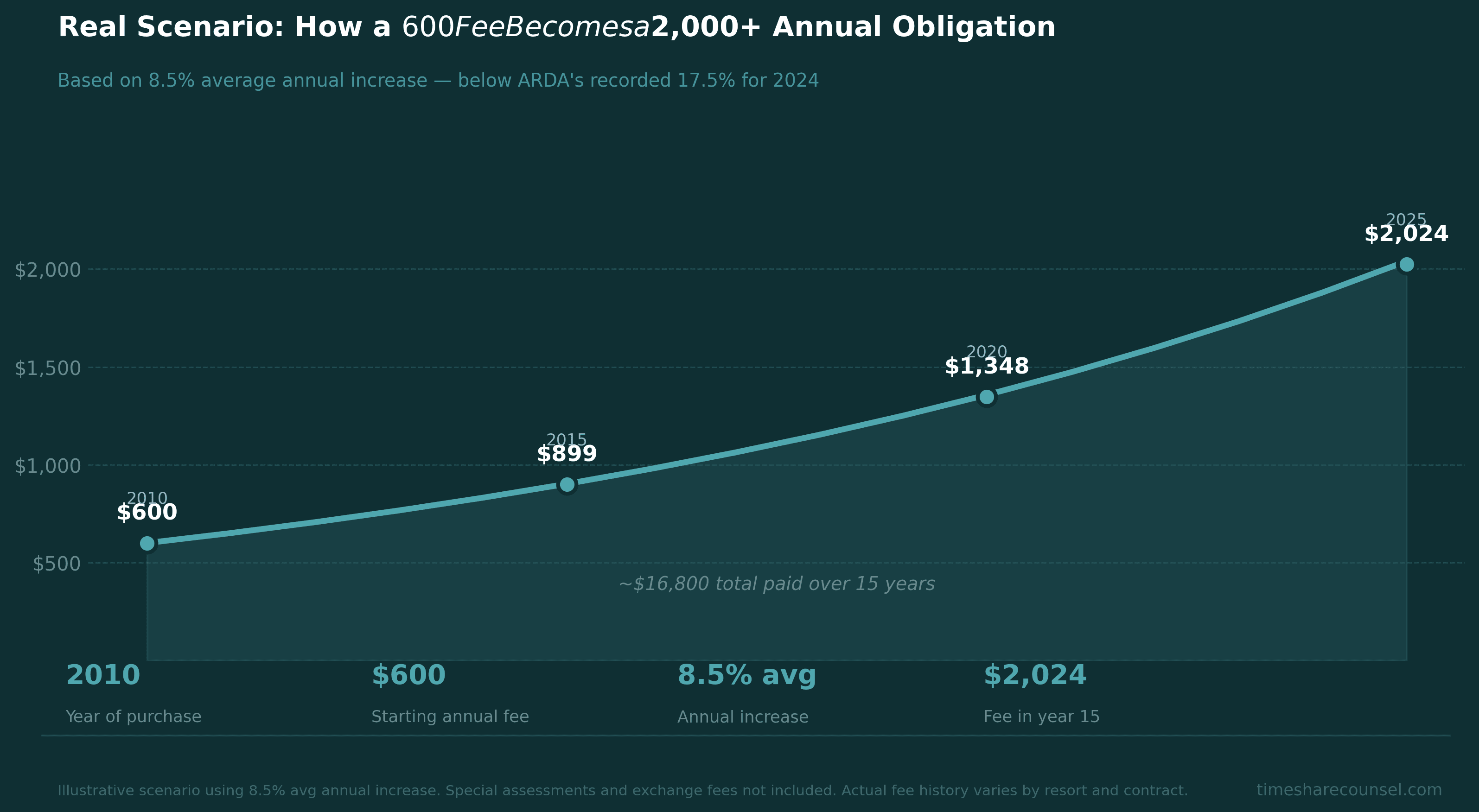
This scenario uses an 8.5% average annual increase, below the 17.5% recorded by ARDA for 2024 and within the typical 5 to 10 percent range cited by industry analysts. The original $600 fee was not an unusual starting point for contracts written in 2010. Special assessments and exchange program fees are not included in this estimate.
What Happens When You Stop Paying
Before exploring exit options, owners need to understand what non-payment looks like in practice. The consequences are real, and they escalate in a predictable sequence.
Late fees and interest: most contracts impose late fees immediately after the due date, often 10 to 18 percent annually on the unpaid balance, which compounds the amount owed quickly
Collection activity: unpaid maintenance fees are sent to collections, typically within 60 to 90 days; collection calls, letters, and third-party agency involvement begin at this stage
Credit reporting: the delinquency is reported to credit bureaus and can remain on your credit report for up to seven years, affecting your ability to obtain mortgages, car loans, and other credit
Foreclosure: Many timeshare contracts, particularly deeded real property interests, give the resort the right to foreclose on the ownership interest for nonpayment of maintenance fees; this process and its timeline vary by state
Deficiency judgment: if the foreclosure sale does not fully satisfy the amount owed, the resort may pursue a deficiency judgment for the remaining balance in states that permit this
An important note on payment strategyTimeshare Counsel LLC does not advise owners to stop making payments as an exit strategy. The consequences described above are real and can cause long-term financial harm that outlasts the timeshare obligation itself. If you are considering stopping payments, speak with an attorney before doing so.
When Rising Fees Become Legal Grounds for a Cancellation Case
For some owners, the fee situation is not just a financial problem. It is also a legal one.
If you were told during the original sales presentation that maintenance fees were fixed, that they would increase only modestly or in line with inflation, that they would be offset by rental income from your unused weeks, or that you would be able to sell the timeshare if the fees became burdensome, and none of those representations turned out to be accurate, you may have grounds for a legal challenge based on misrepresentation or fraudulent inducement.
These are the statements owners report most frequently:
"Your maintenance fees will never go above X amount."
"You can rent your week and cover the fees entirely."
"This is an asset you can sell if you ever need to."
"Fees only go up about 2 or 3 percent a year, just like inflation."
None of these statements, if made at the point of sale, were guaranteed by the contract. If the contract you signed said something different from what you were told verbally, the gap between the sales presentation and the actual contract terms may be the basis for a misrepresentation claim. Whether that gap rises to the level of a legally actionable claim depends on the specifics of your contract, the applicable state law, and the evidence available about what was represented to you.
This is not a determination that can be made without a review of your actual documents. But it is a question worth asking, because for owners who have experienced dramatic and unexpected fee increases, it is often the most direct legal path available.
Owners who fit the profiles most likely to have experienced misrepresentation during the sales process include those who purchased under high-pressure conditions at resort presentations, those who were actively discouraged from reviewing the contract with an attorney before signing, and those who were presented with income projections that never materialized. According to ICP data reviewed in the preparation of this content, 85 percent of timeshare owners report regretting their purchase, and fee escalation is consistently cited as the primary driver of that regret.
What Owners Can Actually Do
The realistic options available to an owner frustrated by maintenance fee increases depend on the specific details of their contract and ownership history. Here is an honest overview of the paths most commonly available:
Request a developer deed-back or surrender program.Some major resort brands offer programs through which owners in good standing, with no outstanding loan balance, can voluntarily return their timeshare. These programs are not publicly advertised, are not guaranteed, and may be paused at any time. They are worth requesting directly from the resort as a first step.
Explore negotiated release based on hardship.If you have documented financial hardship, a medical situation, or are beyond a certain age, some developers will consider a negotiated release from the ownership obligation. Documentation matters, and having an attorney involved strengthens the position significantly.
Request an attorney-supervised contract review.If misrepresentations were made during the original sale, specifically about fee levels, resale value, or rental income, a review of your contract and circumstances by a licensed attorney is the right first step toward understanding whether a legal challenge is viable.
Address an inherited timeshare through the probate process.If you are an heir who has inherited a timeshare you do not want, the disclaimer window is short and state-specific. An attorney review of your options before that window closes is essential.
What does not work: listing the timeshare on a resale site and expecting it to sell. According to industry data, the overwhelming majority of timeshare resale listings attract no buyers or sell for nominal amounts. The supply of owners trying to exit far exceeds any demand to purchase. Resale is not a realistic exit strategy for most owners.
Maintenance fees are the financial reality that most owners eventually confront after years of hoping the situation will improve or resolve itself. The contracts that authorized those fees were written to protect the resort's revenue, not the owner's budget. Understanding what the contract actually says, what options it allows, and whether any legal grounds exist for challenging the underlying obligation is the starting point for making a decision based on facts rather than frustration.
Legal Disclaimer: This article is provided for informational purposes only and does not constitute legal advice. Reading this content or submitting a form on this website does not create an attorney-client relationship. Fee data cited in this article is sourced from the American Resort Development Association (ARDA) and Ernst and Young's 2025 State of the Vacation Timeshare Industry report. Individual fee histories and contractual terms vary. Whether any legal grounds for cancellation exist in a specific case depends on the facts of that case and the applicable state law. Timeshare Counsel LLC does not advise owners to stop making payments. Every situation is unique, and owners should seek individualized legal guidance before taking action on their timeshare obligation.